105 years ago, on May 20, 1921, Karl Dedecius was born — an outstanding translator of Polish literature into German. Thanks to his titanic work as a translator, several thousand Polish poems (including works by Herbert, Miłosz, and Szymborska) reached German readers and travelled even further: to the West, to what was then called the “free world.” Dedecius’s work as a cultural ambassador enabled Polish culture – at that time tightly separated from the rest of Europe by the Iron Curtain – to actively co-create European heritage and participate in international literary exchange.
But Karl Dedecius was also a visionary who believed deeply in the transformative power of culture, which — as he wrote in his autobiography A European from Łódź – makes it possible to “build bridges between East and West, preserve tradition, restore faith in the importance of the Polish word, Polish art, and history.” Dedecius’s belief in the fundamental role of literature led to his original idea of a European Academy. According to this vision, Kraków – a cultural center situated at the crossroads of East and West, North and South – should once again become a salon of Europe: a place for creative dialogue and debate around the key concepts shaping European identity.
Dedecius’s idea materialized in the space of Willa Decjusza — and what made it happen was… a walk.
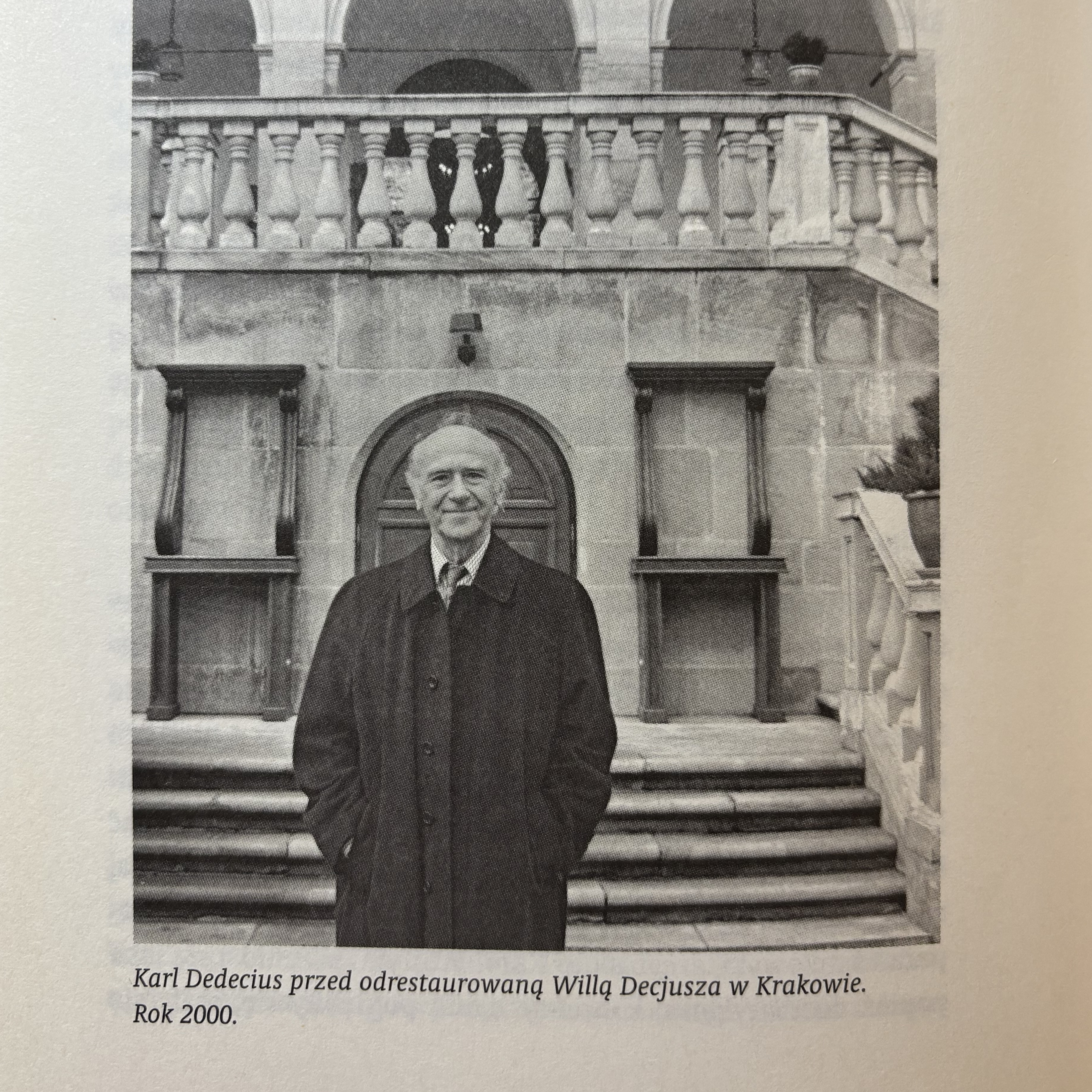
During another stay in Kraków, Dedecius was invited by Wisława Szymborska on a short excursion to the “park and forest landscapes of the suburban area” of Wola Justowska. “(…) We walked,” the translator later recalled, “along a wide country road until we finally stopped in front of a ruined palace which, despite its state of decay, still radiated its former splendor and Italian charm.” In this way, Karl Dedecius discovered the history of a place whose roots date back to the 16th century and are connected with the work of Ludwik Justus Decjusz, secretary to King Sigismund the Old. The heritage of this place, its spirit grounded in the values of tolerance and Renaissance humanism, spoke strongly enough to Dedecius’s imagination that his vision of a European Academy ultimately took shape precisely in Wola Justowska, Kraków. Since 1996, the restored palace and park complex has served as the seat of a cultural institution whose first director was Albrecht Lempp, Dedecius’s closest collaborator.
Bibliography:
Karl Dedecius, Europejczyk z Łodzi: Wspomnienia, translated by S. Lisiecka, Wydawnictwo Literackie, Kraków, 2008.