Video

24th edition of the Visegrad Summer School was hosted in Villa Decius between 7 and 15 of July.

The project is co-financed by the governments of Czechia, Hungary, Poland and Slovakia through Visegrad Grants from the International Visegrad Fund. The mission of the fund is to advance ideas for sustainable regional cooperation in Central Europe.

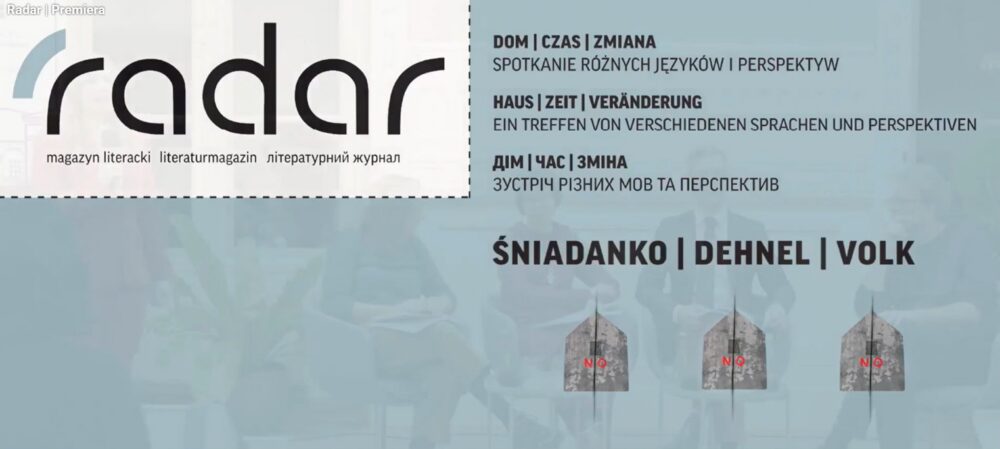
On January 17, 2023, in Kraków, the premiere of a special issue of the magazine RADAR took place, combined with a discussion with the authors and translators titled “DOM.CZAS. CHANGE – A Meeting of Different Languages and Perspectives,” featuring Natalka Śniadanko, Jacek Dehnel, Andreas Volk, and Urszula Pieczek.

“Radar” is an international literary magazine published in German, Polish, and Ukrainian, which was published at Villa Decius from 2010 to 2014. The idea behind “Radar” was to create a shared space for dialogue among writers from various parts of Europe participating in literary residencies at Villa Decius. Through the topics covered in its pages, “Radar” bore witness to many historical events significant not only for these countries but also, in a broader sense, for all of Europe. The magazine’s innovative trilingual format was specifically designed to present a three-sided perspective on experiences shared by Poles, Germans, and Ukrainians.

Organizer and publisher:
Villa Decius Association
Villa Decius Institute of Culture

Translated with DeepL.com (free version)

It seems to me that the story of Karl Gott can be told as the story of Czechoslovakia,” says Pavel Klusák, who worked in Krakow during the summer 2020 on the biography of the author of “Lady Karneval” as part of the Visegrad Literary Residencies.
The Visegrad Literary Residency Program, established 2012 by the International Visegrad Fund, consists of a series of residency stays and literary events addressed to writers of fiction and non-fiction, poets, essayists, critics as well as literary translators, publicists and journalists from the Visegrad Countries (Czech Republic, Hungary, Poland and Slovakia). It is based on a partnership of 4 Host Institutions, one in each V4 country: Institut umeni (Arts Institute) in Prague, Petőfi Irodalmi Múzeum (Petőfi Literary Museum) in Budapest, Stowarzyszenie Willa Decjusza (Villa Decius Association) in Krakow and Literárne informačné centrum (Centre for Information on Literature) in Bratislava.

“Fantasy shows that every human being is different, and none of us is perfect. In a sense, we’re all monsters,” says Mónika Rusvai, a Hungarian writer who spent the summer in Kraków working on her next fantasy novel as part of the 2020 Visegrad Literary Residencies.

The program is an initiative of the International Visegrad Fund, consisting of a series of residencies and literary events aimed at writers, poets, essayists, critics, literary translators, translators of literature, and journalists from the Visegrad Group countries (the Czech Republic, Poland, Slovakia, and Hungary) who have published at least one book or three pieces in newspapers, magazines, or electronic media. The program is based on a partnership among four host institutions from each V4 country: the Institute of Arts in Prague, the Petőfi Literary Museum in Budapest, the Villa Decius Association in Kraków, and the Literary Information Center in Bratislava.

On April 1, 2025, as part of the ARTS in Exile project, an immersive theater performance took place at Villa Decius: WHO WANTS MY LAND? directed by Butrint Pasha, a director and playwright from Kosovo who uses elements of the Theatre of Cruelty and the Poor Theatre in his work, emphasizing the symbolism of war, memory, and forgiveness.

This work was produced with the financial assistance of the European Union. The views expressed herein can in no way be taken to reflect the official opinion of the European Union.

By using this site, you agree to the use of cookies. You can change your cookie settings at any time, and learn more about cookies